by Terry MacCauley - Posted 10 hours ago
The automotive industry has never lacked leads, tools, or technology. What it lacks today is something far more foundational.
Sales training.
Not onboarding.
Not scripts.
Not automation.
Real, layered, disciplined sales development.
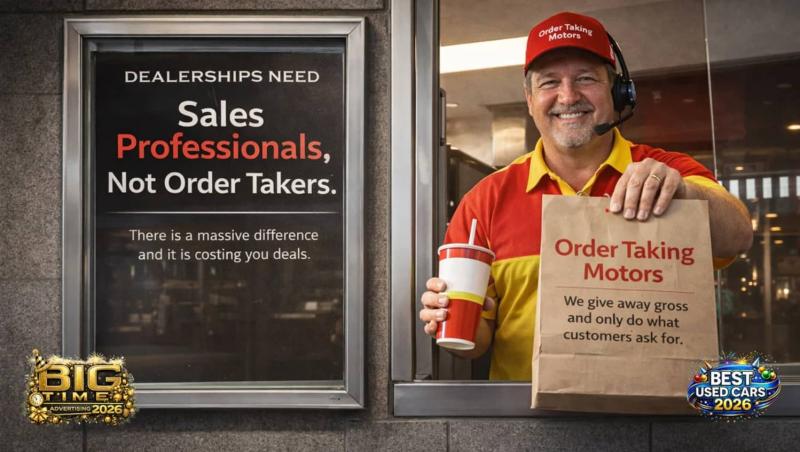
Across the country, dealerships are unintentionally turning salespeople into order takers. This shift is costing stores deals, margin, and long-term customer relationships. It is happening quietly, through early lead disqualification, over-reliance on automation, and a misunderstanding of what selling actually requires.
Selling is not simple.
Selling is not one skill.
Selling is hundreds of skills working together in sequence, timing, and tone.
Many dealerships treat sales as if it were a transactional role. The assumption is that if the advertising works, the customer will arrive ready to buy, approved, and aligned with dealership requirements.
That assumption is false.
Customers come with uncertainty, fear, past experiences, misinformation, and financial limitations. Sales exist because customers need guidance through complexity.
When sales are reduced to processing approved buyers, the dealership becomes dependent on perfect conditions rather than skilled execution.
An order taker waits for alignment.
A salesperson creates alignment.
Order takers ask what the customer wants.
Salespeople uncover what the customer needs and why it matters.
Order takers are reactive.
Salespeople are intentional.
This difference is not personality-based. It is training-based.
Great sales conversations begin with questions that create clarity, not questions that collect surface information.
Yes-based questions build momentum and agreement early. Control questions guide the direction of the conversation without confrontation. Open-ended questions uncover motivation, urgency, and emotional drivers.
A salesperson does not ask what vehicle the customer wants. A salesperson asks what problem the vehicle needs to solve, what prompted the search, and what success looks like for the customer.
These questions create context. Context creates trust. Trust creates movement.
Without this skill, conversations stall at price, payment, or approval.
Rapport is often misunderstood as casual conversation. In reality, rapport is structured trust building.
Salespeople learn how to mirror tone and pace, listen actively, repeat key phrases, and validate emotions without surrendering control of the process.
When a customer expresses concern, the salesperson acknowledges the feeling, explains the process, and demonstrates how the dealership reduces risk for the customer.
This transforms fear into confidence.
Order takers hear concerns and move on.
Salespeople resolve concerns before they harden into objections.
Product knowledge is not about memorizing features. It is about understanding how inventory selection affects outcomes.
Sales professionals know which vehicles improve approval odds, how mileage and price affect structure, and how to position alternatives without diminishing value.
When a deal struggles, a trained salesperson adjusts the solution while preserving the customer's emotional investment.
This skill alone separates closers from processors.
Money conversations are where most untrained salespeople retreat.
A customer says they only have five hundred dollars down. An order taker treats that statement as final. A salesperson understands it is a starting point.
Sales professionals know how to explore flexibility, timing, trade equity, external support, and future income without making the customer uncomfortable or defensive.
The most effective way to increase the down payment is not negotiation. It is a desire.
When a customer is emotionally invested in the right vehicle and trusts the salesperson, solutions appear.
This does not happen digitally alone. It happens in the showroom, face-to-face, guided by skill.
Urgency is not force. Urgency is clarity about reality.
Salespeople explain inventory cycles, market conditions, availability, and timing honestly. They help customers understand the cost of waiting without creating fear.
Order takers wait for customers to decide.
Salespeople help customers decide.
This difference determines whether momentum continues or disappears.
Every objection is a request for reassurance.
Sales professionals are trained to slow down, clarify, isolate, and resolve concerns one at a time.
When a customer says they need to think about it, a salesperson explores what information is missing. When a customer mentions credit fear, a salesperson explains the process and removes uncertainty.
Order takers accept objections.
Salespeople manage them.
Closing is not a single question at the end of the deal. It is the natural outcome of dozens of small agreements built throughout the conversation.
Sales professionals use trial closes, assumptive language, and clear next steps to keep the customer moving forward with confidence.
They do not ask if the customer wants to buy. They help the customer choose how to proceed.
AI-assisted responses and automated follow-ups are powerful tools. Used incorrectly, they create a dangerous gap.
Salespeople stop engaging early.
Ownership disappears.
Skill development stalls.
When automation handles persuasion, and salespeople handle fulfillment, the role of selling erodes.
Technology should support salespeople, not replace their need for skill development.
Dealerships that win will not be the ones with the most automation.
They will be the ones who invest in:
Ongoing sales training
Conversation-based coaching
Skill accountability
Sales ownership
Selling is a craft.
It is learned.
It is practiced.
It is refined.
Order takers wait for perfect conditions.
Sales professionals create results in imperfect ones.
The future belongs to dealerships that remember how to sell.
At Big Time Advertising and Marketing, we are proud to offer far more than advertising execution. We believe that lead conversion improves only when sales skills improve, which is why sales training is one of our core value-added services. We draw on proven fundamentals from respected industry leaders, including Joe Verde, Grant Cardone, Jim Ziegler, Sean V. Bradley, Brian Maxwell, and others, then refine them into clear, digestible lessons that sales teams can actually apply. Most importantly, we adapt those principles to how customers buy today, integrating modern technology, digital communication, and real-world showroom processes. Advertising opens the door. Trained sales professionals close the deal. Our role is to help dealerships master both.
- by Terry MacCauley Founder & CEO
This week’s Big Time educational video is "I Ranked the Best AI Tools to Make Money in 2026" by Dan Martell.
After testing 500+ tools, Dan breaks down which AI platforms are actually worth your time—and which ones are just hype. If you're looking to 10x your income with smarter tools (not just shinier ones), this is your cheat sheet for what works in 2026.